
“Science knows no country, because knowledge belongs to humanity, and is the torch which illuminates the world.”
Louis Pasteur
Click here for Science curriculum outline
Why do we study Science?
The Science curriculum is intended to teach students about the incredible world that they live in and how they grow as humans and develop and thrive in the incredible, diverse and ever changing planet we live on. Students will gain a range of skills and knowledge throughout their science lessons including teamwork and practical skills when completing scientific experiments and debating and literary techniques when considering the impact of scientific theories and practices. Development of a student’s scientific knowledge will be vital to a student’s progression and the sciences are separated into Biology, Chemistry and Physics, to ensure pupils are able to fully comprehend the breadth and depth of this awe inspiring subject. The schemes of work have been carefully planned to ensure students develop in-depth knowledge and understanding of the sciences and are scaffolded to ensure that complex concepts are accessible and are explicitly developed from Key Stage 3 into Key Stage 4. Practical work is at the heart of the 3 sciences and students complete a wide variety of investigations throughout both Key Stages, to allow students to fully immerse themselves into their learning journey. Students will have many opportunities to develop their spiritual, moral, ethical, social and cultural understanding and discuss their personal interpretations and ideas, to develop themselves as a well-rounded, scientifically aware citizen of the world.
Science programme of study at Key Stage 3 (Years 7-9)
Students at Key Stage 3 will be assessed throughout the year with formal exam questions and ‘How Science Works’ investigation to ascertain the grade at which they are working and how they have improved during their studies. The topics they cover are listed under the separate year group headings.
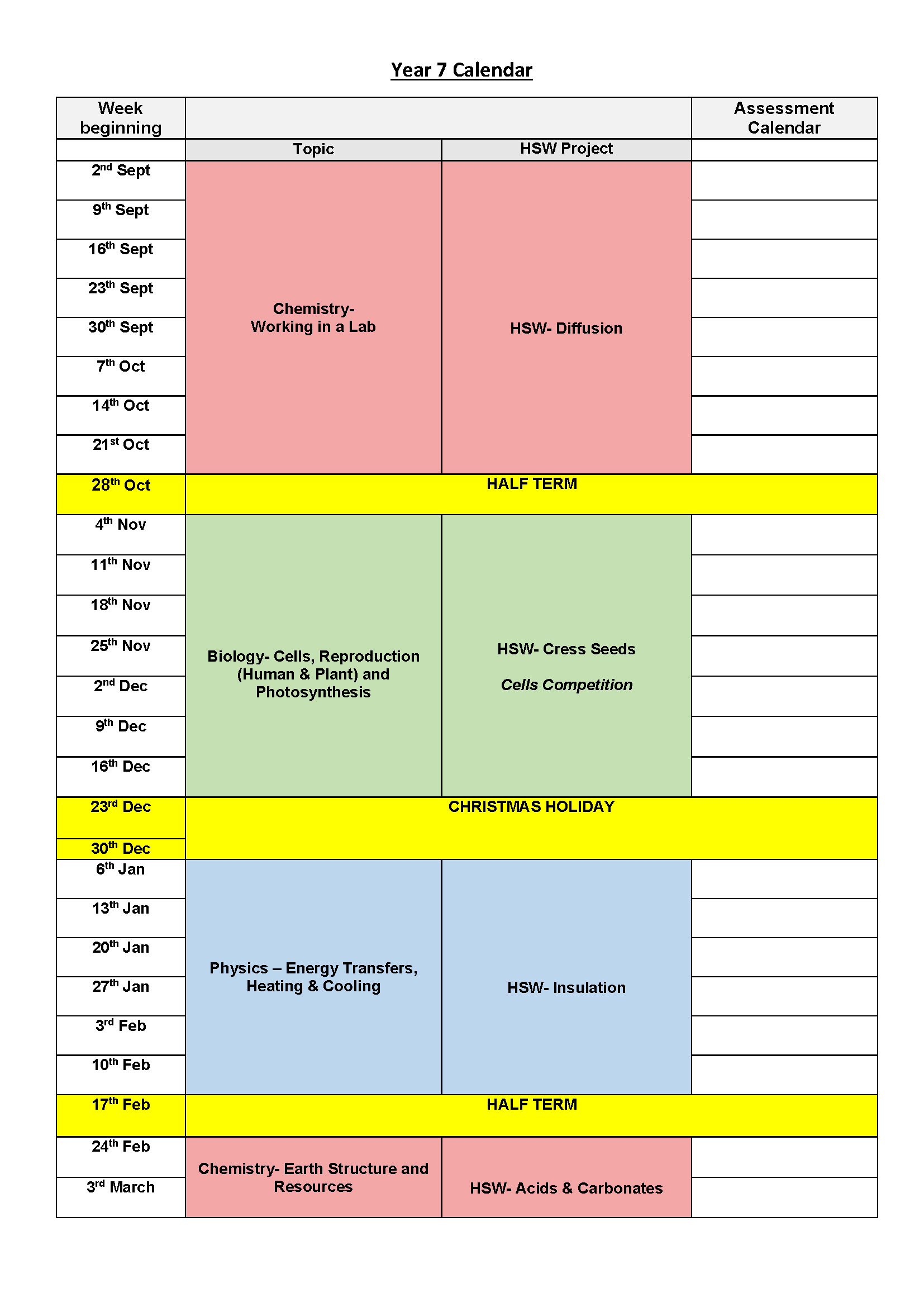
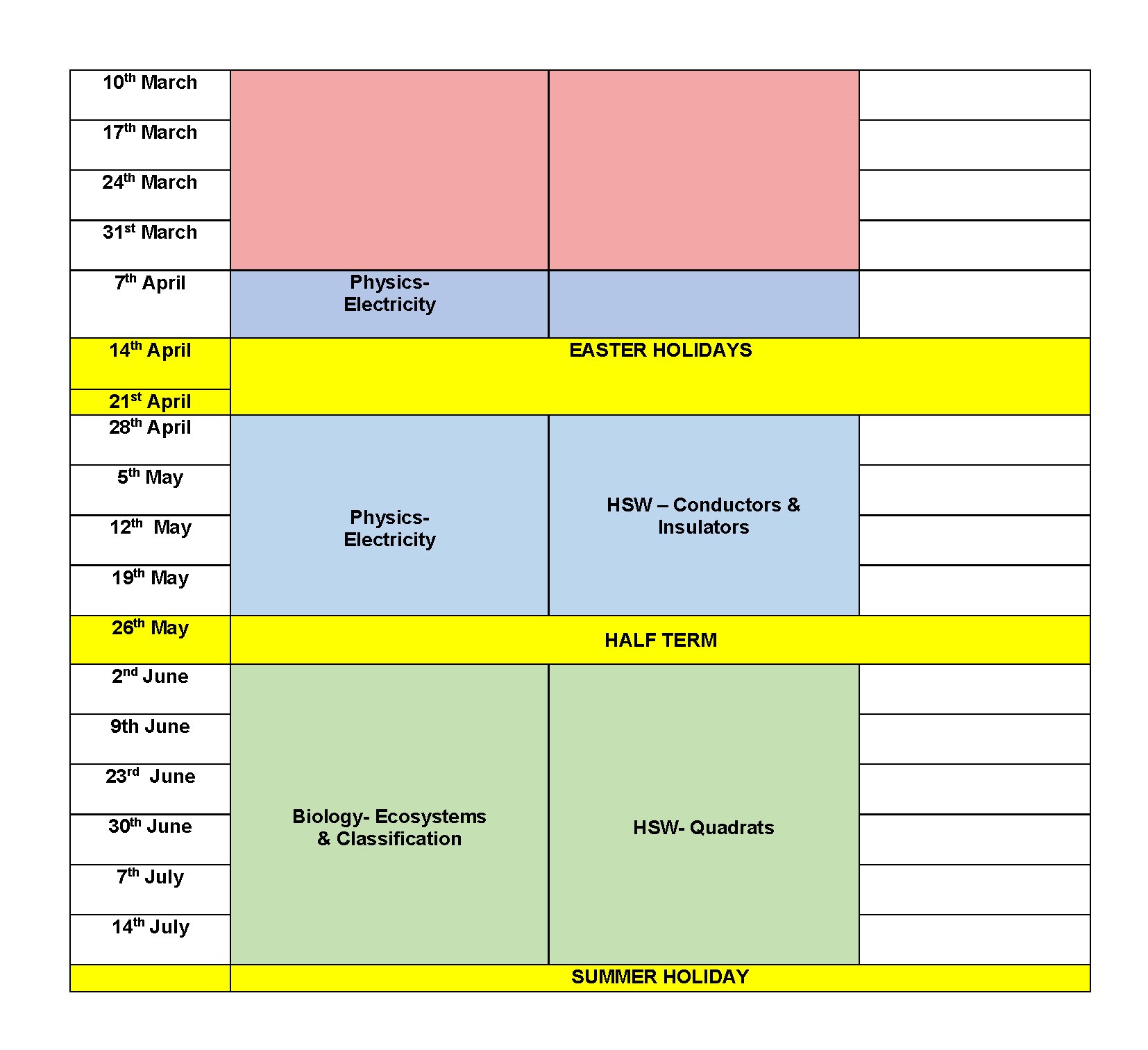
Year 7 Science Topics:
In Year 7 students look at topics covering the full range of sciences, Biology, Chemistry and Physics in an interesting way which links these subjects with day to day life.
Areas covered are:
Year 8 Science Topics:
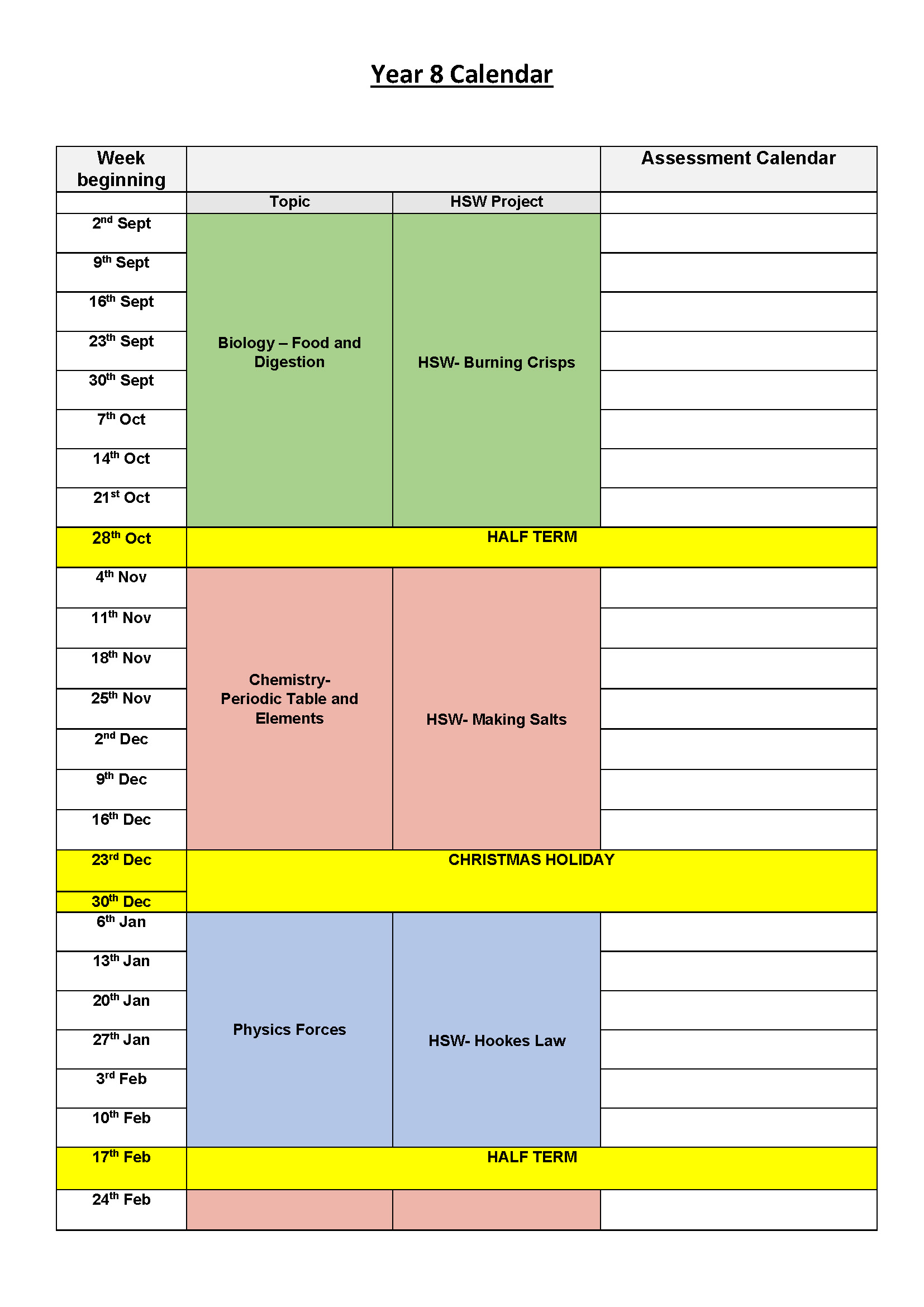
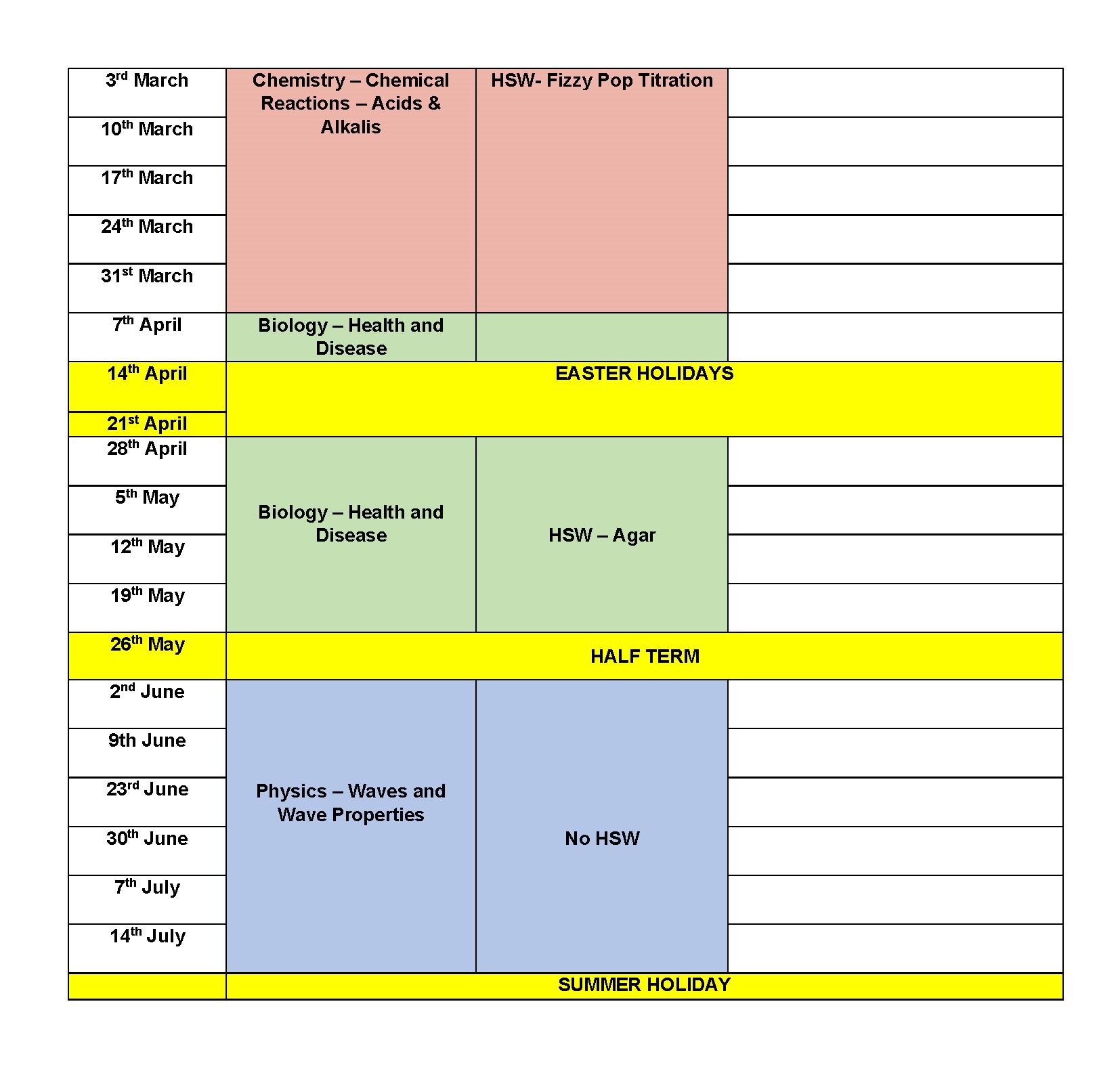
In Year 8 students continue their studies from Year 7 in Biology, Chemistry and Physics. The topics still link the subjects with day to day life and areas covered are:
Year 9 Science Topics:
In Year 9 students continue to extend and consolidate their studies from Year 7 and 8 in Biology, Chemistry and Physics. The topics will prepare students for the transition into their GCSE Combined/Triple science options:
Biology
- Cells/Respiration/Breathing
- Photosynthesis
- Digestion
- Reproduction/Inheritance/ Variation
Chemistry
- Periodic Table and Elements
- Chemical Energy
- Chemical Reactions
Physics
- Forces
- Electricity
- Energy
- Waves
Science programme of study at Key Stage 4 (Years 10-11)
At Key Stage 4 Science can be studied in 2 ways depending on how deeply students wish to pursue the subject at 16+. All pupils will follow AQA specifications.
Students select their options during Year 9.
At GCSE level, students complete the AQA Specification. Students will have opted for either Triple Award Science or Combined Science.
There are two Options:
1) Triple Award = Separate Sciences, GCSE Biology, GCSE Chemistry and GCSE Physics.
Therefore students will be awarded 3 GCSEs grades 9 to 1.
2) Combined Science “Trilogy” = this double award is equivalent to two GCSEs.
Students will study some Biology, some Chemistry and some Physics. Students will then be awarded Two GCSEs grades 9 to 1.
Triple Award
This is great preparation for those students wanting to study any science at AS and A level. Students will cover more content than GCSE Combined Sciences.
Students need to be working at a Grade 4 or above.
Each week students will have lessons of Biology, Chemistry and Physics. These will be taught by specialist teachers. Lessons will cover the new AQA specification and will cover subject content supported by integrated practical work.
At the end of Year 11 students sit 2 Biology papers, 2 Chemistry papers and 2 Physics Papers. Each paper is 1 hour 45 minutes long. Students can sit foundation or higher tier. Each paper is 100 marks. All papers will assess knowledge and understanding as well as scientific ability.
Students will be awarded 3 grades from 9 to 1.
| Biology Content | Chemistry Content | Physics Content |
|
|
|
Combined Science
This double award is equivalent to two GCSEs similar to the current core and additional science which many families are familiar with.
Each week students will have 2 lessons of Biology, Chemistry and Physics. These will be taught by specialist teachers. Lessons will cover the new AQA specification and will cover subject content supported by integrated practical work.
At the end of Year 11 students sit 2 Biology papers, 2 Chemistry papers and 2 Physics Papers. Each paper is 1 hour 15 minutes long. Pupils can sit foundation or higher tier. All papers will assess knowledge and understanding as well as scientific ability.
Each paper is worth 70 marks with a range of questions including questions accessible for all students.
Students will be awarded 2 grades from 9 to 1 e.g. 9-9, 9-8 through to 2-1,1-1.
| Biology Content | Chemistry Content | Physics Content |
|
|
|
Homework expectations
How can parents and guardians support at home?
As well as monitoring homework via the online learning platforms, there are a range of ways in which parents and guardians can help to support their child with developing their Science skills.
Teachers will incorporate effective revision strategies into their teaching, but we are always grateful for the support offered at home to reinforce these techniques. Look out for A3 pieces of paper dotted around their bedrooms with ‘Mind-maps’ of their topics and revision summary sheets! Also check they are using their revision guides and online resources to support their revision!
Some other techniques that might help students when preparing revision materials are:
- Using images (not works of art, just simple sketches) to connect key quotations together. Such images can really help some students to remember content;
- Using colour – this will often help students to remember different concepts as well as the different sections in the exam;
- A different mind map for each topic;
- Buying a revision guide and asking your child the questions from each section to check their understanding of the topic. Study guides can be purchased via the Science department for a reduced price;
How can I help with Science?
- Ensure your son/daughter has prepared revision cards;
- Time your son/daughter with practice questions (often made available via the online ‘blue tab’ or through their class teachers) and encourage them to be handed in to be marked by their teacher
Useful websites for revision:
Combined Science- https://www.bbc.co.uk/bitesize/examspecs/z8r997h
Biology- https://www.bbc.co.uk/bitesize/examspecs/zpgcbk7
Chemistry- https://www.bbc.co.uk/bitesize/examspecs/z8xtmnb
Physics- https://www.bbc.co.uk/bitesize/examspecs/zsc9rdm
KS3 Science- https://www.bbc.co.uk/bitesize/subjects/zng4d2p
Online videos- https://www.youtube.com/c/Freesciencelessons
Year 11 students will also have exclusive access to a bespoke set of resources via the school website (often referred to as the ‘blue tab’).
Extra-curricular opportunities
Students will also experience science in action with regular practical activities, both inside and outside of the classroom, where they can undertake scientific investigations to explain key ideas, develop their understanding and practical skills. There are regular real-life opportunities of scientific experiences both in the classroom, during lessons, CSI experiences and science clubs, as well as externally at the Big Bang Show and university events.
Across the academic year, such opportunities include:
- Year 7 CSI Event
- STEM Club
- KS4 University Events
- Pokémon Club
- Aspiring to A-Level
- Key Stage 3 D&D club
